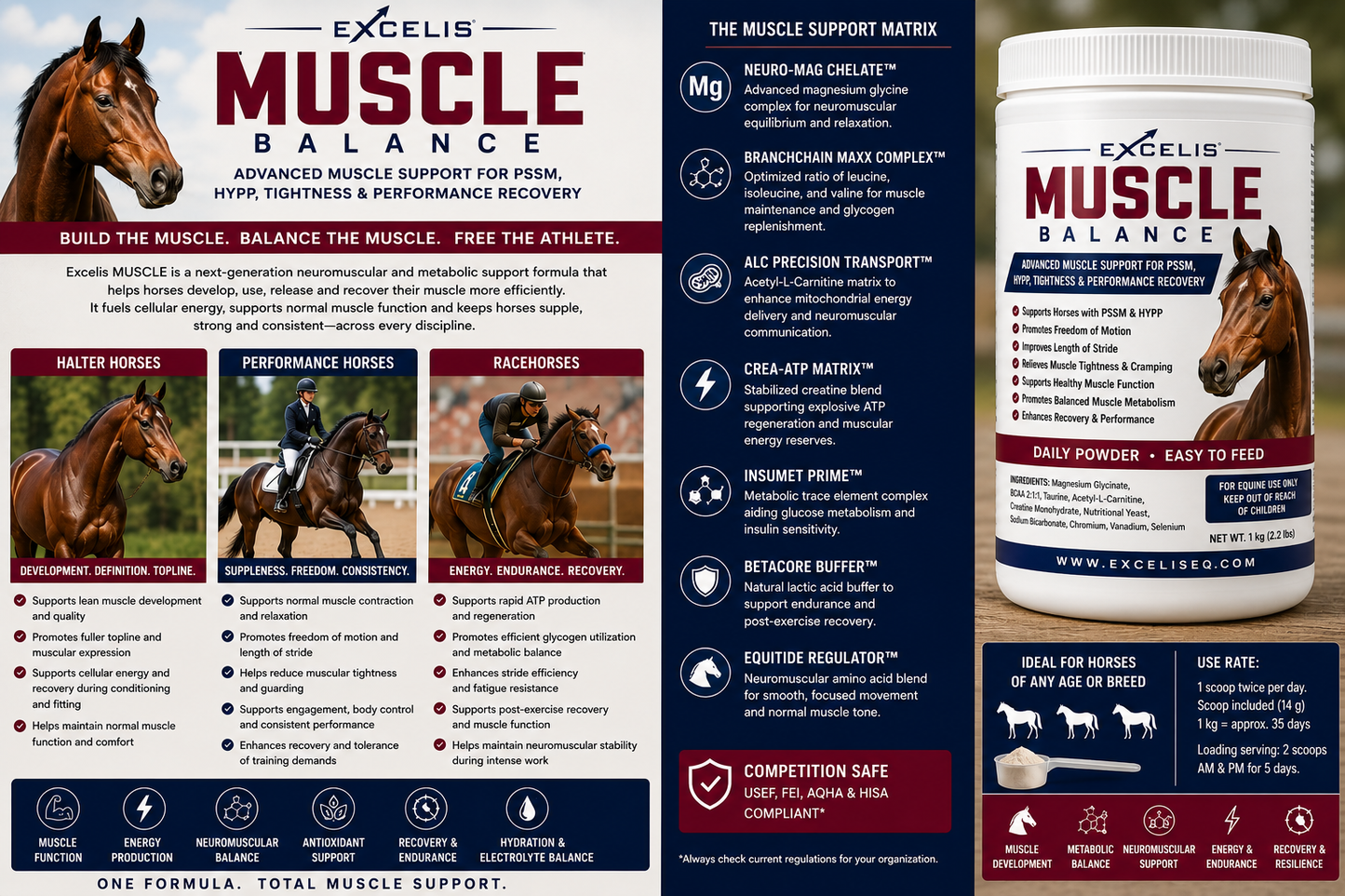
Excelis MUSCLE™
Advanced Muscular Balance, Metabolic Efficiency and Athletic Development
Different Horses. Different Demands. One Muscular System.
A halter horse needs muscular development, definition and expression.
A performance horse needs suppleness, body control, freedom of motion and the ability to contract and release without becoming tight or guarded.
A racehorse needs rapid energy production, efficient glycogen utilization, fatigue resistance and dependable recovery from intense work.
These horses may look different and perform different jobs, but their muscles depend on the same biological processes.
Excelis MUSCLE™ was developed to support those processes at the cellular, metabolic and neuromuscular levels.
It does more than supply ingredients for muscle growth. It helps the horse develop, use, release and recover its muscle more efficiently.
Why MUSCLE Is Different
Most muscle supplements focus on one part of the equation.
Some provide amino acids to support muscle tissue.
Some provide magnesium for relaxation.
Some provide creatine for energy.
Some provide metabolic nutrients for glucose utilization.
Excelis MUSCLE brings these systems together in one coordinated formula.
It supports:
Muscular development and maintenance
Neuromuscular communication
Normal contraction and release
Mitochondrial energy production
ATP regeneration
Glucose and glycogen utilization
Cellular hydration and electrolyte movement
Antioxidant protection
Exercise recovery
Freedom and length of stride
This is what makes MUSCLE more than a muscle-building supplement.
It is a complete muscular-function formula.
What Different Horses Actually Need
The Halter Horse
A halter horse needs more than added body weight or temporary fullness.
The objective is quality muscle: balanced development, visible expression, a fuller topline, stronger hindquarters and a body that continues to look and feel healthy under the demands of conditioning, fitting and showing.
To develop that appearance, the horse must be able to:
Produce and maintain lean muscle tissue
Replenish muscular energy stores
Use glucose and amino acids efficiently
Recover from repeated fitting and conditioning sessions
Maintain normal cellular hydration
Avoid becoming excessively tight, rigid or sore
MUSCLE supplies targeted amino acid support for muscular development while also supporting ATP production, mineral balance, metabolic efficiency and recovery.
The result is not simply a horse that looks larger.
The goal is a horse that develops fuller, healthier, more functional muscle—with better topline expression, greater muscular symmetry and the ability to remain comfortable throughout a demanding fitting program.
For the halter horse, MUSCLE supports:
Development. Definition. Topline. Recovery. Muscular quality.
The Performance Horse
A performance horse does not simply need strong muscles.
It needs muscles that can contract powerfully, release completely and respond precisely to the rider.
When muscle remains tight or guarded, the horse may become:
Shortened in its stride
Restricted through the shoulder
Tight through the back or loin
Resistant in transitions
Heavy in the bridle
Reluctant to engage the hindquarters
Inconsistent from one ride to the next
Slow to recover following work
These horses may already possess adequate muscle mass. The problem is often how that muscle is functioning.
MUSCLE supports the neuromuscular and metabolic systems that allow the horse to use its existing strength with greater suppleness, coordination and freedom.
Magnesium supports normal nerve signaling and muscular release. Taurine supports cellular balance and neuromuscular stability. Creatine supports rapid muscular energy. Acetyl-L-carnitine supports mitochondrial activity and communication between the nervous and muscular systems.
Together, these nutrients help create a horse that can stay strong without becoming rigid, remain powerful without becoming restricted and maintain athletic expression throughout the ride.
For the performance horse, MUSCLE supports:
Suppleness. Length of stride. Body control. Engagement. Consistency. Recovery.
The Racehorse
The racehorse places an extraordinary demand on muscular energy production.
During high-intensity exercise, muscle cells must produce and recycle ATP rapidly. They must draw upon stored glycogen, manage electrolyte movement, maintain normal nerve and muscle communication and recover from significant oxidative and metabolic stress.
A weakness in any part of that system can appear as:
Premature muscular fatigue
Reduced finishing strength
Tightness following work
Prolonged recovery
Exercise intolerance
Loss of stride efficiency
Inconsistent performance
Increased susceptibility to exercise-related muscular discomfort
MUSCLE supports both the immediate and sustained energy requirements of working muscle.
Creatine supports rapid ATP regeneration. Acetyl-L-carnitine supports mitochondrial energy metabolism. Branched-chain amino acids support muscle maintenance and recovery. Metabolic trace nutrients support normal glucose utilization, while magnesium, taurine and electrolyte-supporting nutrients help maintain neuromuscular stability during demanding work.
Antioxidant nutrients help protect working muscle cells from the oxidative stress associated with strenuous exercise.
The purpose is not artificial stimulation.
The purpose is to help the racehorse produce, use and restore muscular energy more efficiently.
For the racehorse, MUSCLE supports:
Energy production. Glycogen utilization. Fatigue resistance. Stride efficiency. Recovery.
Horses With Muscular and Metabolic Challenges
Some horses require more than general performance nutrition.
Horses prone to chronic tightness, exercise intolerance, tying-up tendencies, PSSM-related symptoms or other muscular myopathies may have difficulty managing energy, glucose, glycogen, electrolytes or normal muscle-cell function.
These horses can appear strong and well developed but still struggle to use their muscles normally.
MUSCLE was formulated with these horses in mind.
Its combination of bioavailable magnesium, amino acids, mitochondrial nutrients, metabolic trace elements, creatine, taurine and antioxidant support addresses several of the nutritional systems that can influence muscular comfort and function.
MUSCLE is not intended to diagnose, treat or cure a muscular disorder. It provides advanced nutritional support for horses whose muscular demands exceed what ordinary feeding programs may provide.
The Science Inside MUSCLE
Magnesium Glycinate
Magnesium is essential for normal nerve transmission, muscle contraction, muscular release and cellular energy reactions.
The glycinate form provides a highly bioavailable source of magnesium while also supplying glycine, an amino acid involved in nervous-system balance, connective tissue and cellular function.
Adequate magnesium availability is especially important in horses that become tight, reactive through the body, stiff or slow to release muscle following contraction.
Branched-Chain Amino Acids
Leucine, isoleucine and valine are essential amino acids used directly by muscle tissue.
They support muscle-protein turnover, maintenance, repair and recovery following exercise.
Their value extends beyond simply adding muscle mass. They provide working muscle with the raw materials required to maintain tissue quality during training, conditioning and competition.
Acetyl-L-Carnitine
Acetyl-L-carnitine supports mitochondrial activity and cellular energy production.
Mitochondria are the energy-producing structures within the cell. Their ability to process fuel efficiently influences endurance, recovery and muscular function.
Acetyl-L-carnitine also supports communication between the nervous system and the working muscle, making it especially relevant to horses that require coordination, precision and consistent muscular response.
Creatine Monohydrate
Creatine supports the rapid regeneration of ATP—the immediate energy currency used by muscle cells.
This is important during acceleration, jumping, collection, rapid transitions, intense fitting work and other short-duration, high-output muscular efforts.
Creatine also supports muscular energy reserves, training capacity and recovery.
Taurine
Taurine is involved in cellular hydration, electrolyte movement, calcium regulation and normal neuromuscular function.
These roles are especially important in working muscle, where changes in cellular fluid balance and calcium movement directly influence contraction, release and fatigue.
Metabolic Trace Nutrients
Targeted chromium and vanadium sources support normal insulin activity, glucose transport and energy metabolism.
Efficient glucose utilization is important to every athletic horse, but it becomes particularly significant in horses with metabolic or glycogen-related muscular challenges.
Vitamin E and Selenium
Exercise increases the production of free radicals and oxidative stress within working muscle.
Vitamin E and selenium support the horse’s natural antioxidant defenses and help protect muscle-cell membranes during training and recovery.
These nutrients are particularly important in horses working intensely, receiving limited fresh pasture or experiencing ongoing muscular stress.
What You May See and Feel
With consistent use and an appropriate feeding and conditioning program, owners and trainers may notice:
Fuller, more functional muscular development
Greater topline expression
A softer feel through the horse’s body
Improved length and freedom of stride
More comfortable warm-up periods
Better engagement of the hindquarters
Reduced muscular guarding
More consistent performance
Improved recovery following work
Greater tolerance of training demands
The precise response will depend on the horse, its discipline, its diet and the muscular challenges being addressed.
One Product. Three Distinct Outcomes.
Halter Horses
Build and maintain fuller, higher-quality muscular development.
Performance Horses
Improve muscular balance, suppleness, freedom of motion and consistency.
Racehorses
Support rapid energy production, stride efficiency, fatigue resistance and recovery.
Excelis MUSCLE™
Build the Muscle. Balance the Muscle. Free the Athlete.
Excelis MUSCLE is not based on one ingredient or one theory.
It is a coordinated nutritional system created to support how muscle is developed, how it produces energy, how it communicates with the nervous system, how it contracts, how it releases and how it recovers.
That is why MUSCLE belongs in a category of its own.